


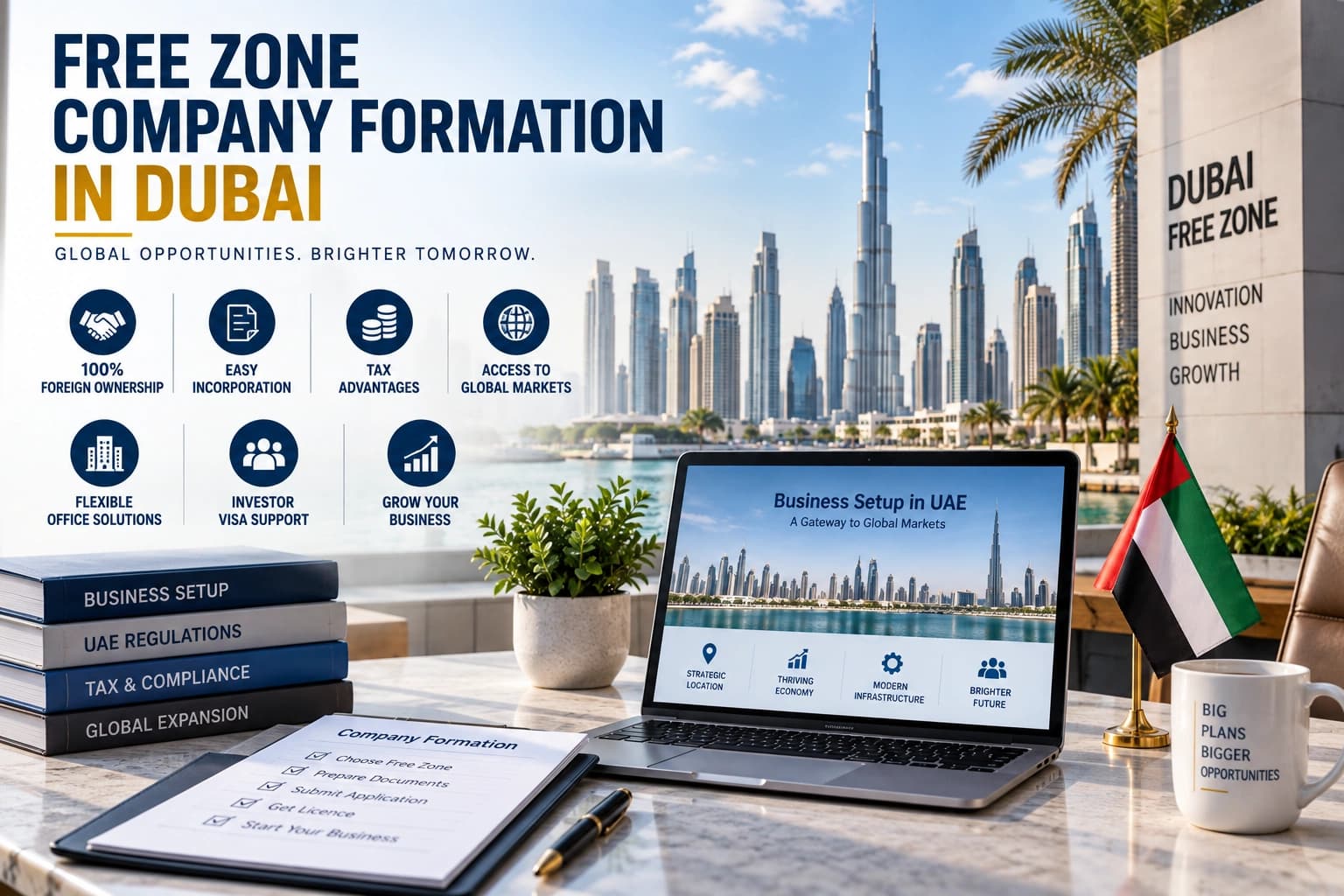
Free Zone Company Formation in Dubai: 7 Key Benefits
Free Zone Company Formation in Dubai: 7 Key Benefits
Starting a business in the UAE can provide entrepreneurs with access to a highly connected commercial environment and a wide range of business activities. For many international investors and entrepreneurs, Free Zone Company Formation in Dubai is an option worth considering because Dubai has established free zones serving sectors such as technology, logistics, media, trading, finance, and professional services.
The UAE Government currently identifies numerous free zones across the country, with free-zone ecosystems supporting different industries and business activities.
However, free-zone company formation is not simply about obtaining a licence. Entrepreneurs need to select an appropriate free zone, determine the permitted business activity, choose the legal structure, understand office requirements, prepare documents, and consider ongoing tax and regulatory obligations.
Horizon Line helps entrepreneurs understand the business setup process and evaluate available options according to their proposed activities and requirements.
Understanding Free Zone Company Formation in Dubai
Free Zone Company Formation in Dubai refers to establishing a business under the regulatory framework of a Dubai free-zone authority. Each free zone has its own rules, permitted activities, licensing procedures, facility options, and commercial requirements.
This means there is no single setup package that applies to every entrepreneur. A technology startup, trading company, consultancy, logistics business, and media company may have different requirements depending on the selected jurisdiction and activity.
The UAE Government provides dedicated information and services for businesses operating in free zones, including starting, running, recruiting, accessing services, and closing a free-zone business.
For this reason, choosing the free zone should be one of the first decisions in the setup process. Entrepreneurs should consider their activity, target customers, facility requirements, ownership structure, banking needs, and future expansion plans before selecting a jurisdiction.
Why Choose Free Zone Company Formation in Dubai
Dubai's free zones are designed to support businesses operating across a variety of sectors. The UAE Government notes that free zones are available for areas including retail, agritech, health, FinTech, logistics, media, and ICT.
For international entrepreneurs, a free-zone structure can provide a defined regulatory environment and access to business infrastructure. Depending on the selected free zone and activity, businesses may have access to offices, warehouses, shared workspaces, licensing services, and other facilities.
Free zones can also be relevant for entrepreneurs who want to establish a UAE-based business while serving customers locally, internationally, or through cross-border trade. The exact ability to conduct activities in Dubai's mainland market depends on the business activity, regulatory requirements, and applicable arrangements.
Therefore, entrepreneurs should look beyond general claims about free zones and examine the rules of the specific jurisdiction they are considering.
7 Key Benefits of Free Zone Company Formation in Dubai
1. Access to a Business-Friendly Ecosystem
One of the major attractions of Free Zone Company Formation in Dubai is access to purpose-built business environments. Free zones often bring companies from related industries into dedicated commercial communities.
This can be particularly useful for businesses that need sector-specific infrastructure or want to operate close to suppliers, logistics providers, technology companies, professional service providers, or other businesses.
2. International Business Environment
Dubai has developed extensive connections with international markets. A free-zone business can be structured to support international trading, professional services, consulting, technology, e-commerce, and other permitted activities.
However, the exact scope of permitted business activities depends on the licence and free-zone authority. Entrepreneurs should confirm the permitted activities before incorporating the company.
3. Different Licensing Options
Free zones generally provide licences based on approved economic activities. Depending on the jurisdiction, entrepreneurs may find commercial, professional, industrial, consultancy, technology, media, or other activity-specific options.
The correct licence is important because it defines what activities the company is permitted to conduct. Selecting a licence based only on price can create problems if it does not match the company's actual business model.
4. Flexible Office Solutions
Many free zones provide different workspace options, depending on their rules and available packages. These may include shared workspaces, flexi-desk arrangements, serviced offices, or dedicated commercial premises.
The appropriate option depends on the company's activity, employee requirements, immigration needs, and free-zone regulations. Businesses requiring warehouses or specialized facilities may need a different setup from a consultancy or technology company.
5. Business Infrastructure
A well-developed free-zone environment can provide access to commercial infrastructure and administrative services. Depending on the jurisdiction, this may include licensing support, office facilities, networking opportunities, logistics infrastructure, and business service providers.
This can help entrepreneurs focus on developing their business while using an established commercial ecosystem.
6. Foreign Investor Ownership Structures
Ownership rules depend on the applicable legal framework and business structure. The UAE has introduced reforms supporting foreign ownership in many business contexts, while free-zone companies operate under the relevant free-zone authority and applicable federal rules.
Entrepreneurs should therefore confirm the ownership structure applicable to their selected free zone and proposed activity instead of assuming that identical rules apply everywhere.
7. Potential for Business Expansion
A free-zone company can provide a foundation for entrepreneurs who plan to develop their UAE presence over time. As the business grows, the company may need additional employees, office space, warehouses, licences, or related activities.
Planning for future requirements at the incorporation stage can help avoid unnecessary restructuring later.
Steps for Free Zone Company Formation in Dubai
The first step in Free Zone Company Formation in Dubai is identifying the business activity. The activity should accurately represent what the company intends to conduct.
The next step is selecting an appropriate free zone. This decision should consider permitted activities, location, facility requirements, licence type, ownership structure, visa requirements, and expected operating costs.
After selecting the jurisdiction, the entrepreneur generally proceeds with the application and required documentation. Depending on the free zone, the authority may require information about shareholders, managers, business activities, proposed company name, and other details.
Some free-zone authorities may also require a business plan or additional documentation depending on the proposed activity. For example, published DAFZA regulations include incorporation documentation and provisions concerning business plans and premises for certain companies.
Once the application and required approvals are completed, the applicable licence and incorporation documents can be issued according to the free zone's procedures.
Documents and Requirements
Documentation depends on the chosen free zone, company structure, business activity, and applicant profile. Commonly requested information may include passport copies, photographs, proposed company names, business activity details, shareholder information, and application forms.
Additional documentation may be required for corporate shareholders, regulated activities, specialized sectors, or certain professional licences.
Entrepreneurs should also be prepared to provide information about the intended business activity and facility requirements. Where the free zone requires physical premises, the appropriate office, warehouse, or other facility may need to be arranged.
Because requirements can change between jurisdictions, applicants should obtain the current document checklist directly from the relevant free-zone authority or through a qualified business setup provider.
Costs and Ongoing Considerations
The cost of Free Zone Company Formation in Dubai varies significantly. There is no universal fixed price because expenses can depend on the free zone, licence type, number of shareholders, business activity, office solution, visa requirements, and additional government or administrative charges.
Entrepreneurs should therefore request a detailed quotation that separates incorporation, licence, office, visa, establishment, and other applicable costs.
Ongoing expenses also matter. A company may have annual licence renewal requirements and operational costs associated with premises, employees, visas, accounting, tax compliance, banking, insurance, or other services.
A low initial setup price may not necessarily represent the lowest overall cost over several years. Business owners should compare the complete operating structure instead.
Tax and Compliance Considerations
Tax planning is an important part of establishing a UAE company. The UAE currently applies a federal corporate tax framework to businesses, and the government confirms that corporate tax applies to the net income or profit of corporations and other entities from business activities.
Free-zone businesses should not assume that incorporation automatically means all income is taxed at zero. Specific tax treatment depends on the applicable corporate tax rules and whether the company meets the relevant conditions for any available free-zone treatment.
VAT is also relevant. The UAE currently applies VAT at 5% on taxable supplies, subject to the applicable registration rules and legislation.
Businesses should maintain appropriate accounting records and evaluate corporate tax, VAT, invoicing, customs, beneficial ownership, licensing, and other compliance requirements according to their circumstances.
Because UAE tax and business regulations can change, entrepreneurs should verify current requirements with the Federal Tax Authority, relevant free-zone authority, or a qualified tax and legal adviser.
Why Choose Horizon Line
Horizon Line is Trusted Business Setup Company Provider in Dubai, helping entrepreneurs understand the company formation process and evaluate business setup options in the UAE.
For clients considering Free Zone Company Formation in Dubai, Horizon Line can help organize the setup journey around important decisions such as business activity, free-zone selection, licence requirements, documentation, office solutions, and related setup considerations.
The right approach starts with understanding the entrepreneur's business model. A trading company may have different requirements from a consultancy, technology company, e-commerce business, or logistics operation. Horizon Line can help clients review these requirements before proceeding with the relevant setup process.
Business owners should also consider their long-term plans. If they expect to hire employees, obtain visas, operate a warehouse, conduct international trade, or expand their activities, these requirements should be considered at the beginning.
The objective should be to establish a structure that fits the proposed business activity and remains practical as the company develops.
Frequently Asked Questions
What is Free Zone Company Formation in Dubai?
Free Zone Company Formation in Dubai is the process of establishing a company under the regulatory framework of a Dubai free-zone authority. The company receives a licence for approved business activities and operates according to the rules of its selected free zone and applicable UAE laws.
How much does Free Zone Company Formation in Dubai cost?
There is no single standard cost. The total expense can vary according to the free zone, licence type, business activity, office or workspace requirements, visas, number of shareholders, and other applicable fees. A detailed quotation should be obtained before proceeding.
Can foreigners establish a free-zone company in Dubai?
Foreign investors can establish businesses in UAE free zones subject to the applicable free-zone rules, licensing requirements, business activity, and legal structure. The exact ownership and incorporation requirements should be confirmed with the relevant authority.
What documents are required for a Dubai free-zone company?
Requirements vary by free zone and company structure. Applicants may commonly need identification documents, shareholder information, proposed company details, application forms, and activity-related documentation. Additional documents may apply to corporate shareholders or regulated activities.
Does a free-zone company have to pay corporate tax?
Free-zone companies are within the UAE corporate tax framework, but qualifying income of a qualifying free-zone person may receive specific tax treatment under applicable rules. Businesses should assess their individual circumstances and current legislation rather than assuming that every free-zone company automatically receives a 0% rate.
Can a free-zone company operate in the Dubai mainland market?
A free-zone company's ability to conduct business in the mainland depends on the activity, applicable regulations, licensing arrangements, and any required approvals or structures. Entrepreneurs should verify the rules applicable to their specific business before planning mainland operations.
Why work with Horizon Line for business setup?
Horizon Line can help entrepreneurs understand the available business setup process, compare relevant options, organize documentation, and coordinate setup requirements. The appropriate solution depends on the client's business activity, ownership structure, facility requirements, and future plans.
Conclusion
Free Zone Company Formation in Dubai can provide entrepreneurs with access to an established commercial ecosystem and a structured framework for operating a business in the UAE. However, selecting the right free zone and licence requires careful consideration of business activity, facilities, ownership, visas, costs, taxation, and ongoing compliance.
The most suitable setup is not necessarily the cheapest package. Instead, entrepreneurs should select a structure that matches their current business requirements while allowing practical room for future development.
Horizon Line supports entrepreneurs through the business setup process by helping them understand available options and organize the requirements associated with company formation. From selecting a suitable free-zone structure to preparing documentation and understanding ongoing considerations, professional guidance can make the process more organized.
If you are planning Free Zone Company Formation in Dubai, contact Horizon Line to discuss your business activity, preferred setup structure, licensing requirements, and next steps for establishing your UAE business.