


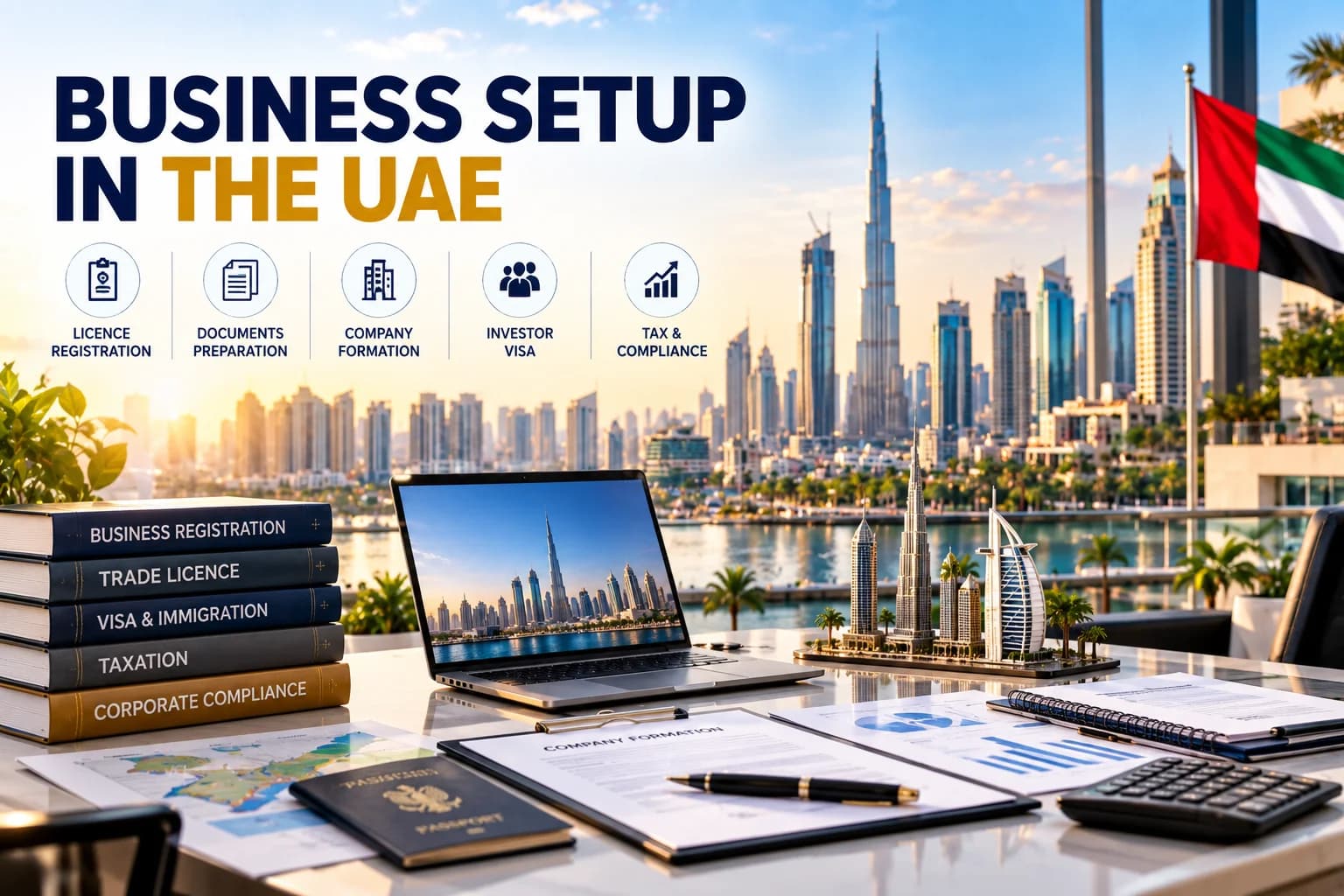
How Business Setup Works in the UAE: 7 Key Steps
How Business Setup Works in the UAE: 7 Key Steps
Understanding how business setup works in the UAE is essential for entrepreneurs planning to establish a company in one of the region's major business markets. The process involves more than simply registering a company. Entrepreneurs need to select a suitable business activity, choose between available jurisdictions, determine the appropriate legal structure, obtain the required licence, prepare documents, arrange premises where applicable, and understand ongoing tax and compliance responsibilities.
The UAE offers several routes for company formation, including mainland and free zone structures. However, the right option depends on factors such as the nature of the business, intended customers, operating location, ownership structure, office requirements, and future plans.
Horizon line helps entrepreneurs understand the company formation process and organize the key considerations involved in establishing a business in the UAE.
Understanding How Business Setup Works in the UAE
To understand how business setup works in the UAE, entrepreneurs should first recognize that company formation is influenced by the proposed business activity and the jurisdiction selected.
The UAE broadly provides mainland and free zone routes for establishing businesses. Each route can involve different licensing authorities, permitted activities, premises requirements, costs, visa arrangements, and operating conditions.
The first decision should therefore not be based solely on an advertised package price. Entrepreneurs should define what the company will actually do, who its customers will be, where it needs to operate, and whether it requires a physical office, warehouse, shop, or other facility.
For regulated or specialized activities, additional approvals may also be necessary. As a result, the setup process should be planned around the actual business model rather than using the same checklist for every company.
Choosing the Right Business Jurisdiction
Jurisdiction selection is one of the most important stages in understanding how business setup works in the UAE.
Mainland Company Setup
A mainland company can be appropriate for businesses that need to operate within the UAE's local market, subject to the rules applicable to the chosen activity and emirate.
The licensing authority, permitted activities, premises requirements, and other conditions can vary. Entrepreneurs should therefore confirm the current requirements applicable to their specific business before incorporation.
Free Zone Company Setup
Free zones provide another company formation route and are commonly used by businesses operating in sectors such as professional services, technology, trading, logistics, media, and other industries.
However, free zones are not identical. Each free zone can have its own permitted activities, licensing packages, facility requirements, visa arrangements, and administrative procedures.
Entrepreneurs should therefore compare the complete structure rather than assuming that every free zone offers the same benefits or operating conditions.
The right choice depends on the company's intended activities, customers, operational requirements, and long-term plans.
How Business Setup Works in the UAE: 7 Key Steps
1. Define the Business Activity
The first practical step is identifying the exact business activity.
Entrepreneurs should clearly describe what the company will provide, sell, manufacture, distribute, or manage. Examples can include consultancy, marketing, information technology, e-commerce, general trading, professional services, logistics, manufacturing, education, and many other activities.
The selected activity should accurately reflect the planned operations. Choosing an unsuitable activity can create problems when applying for licences, opening business facilities, or expanding the company's operations.
Some sectors may also require approval from a relevant government or regulatory authority. Therefore, entrepreneurs should check activity-specific requirements before proceeding.
2. Select the Jurisdiction and Legal Structure
Once the business activity is established, entrepreneurs can assess whether mainland or free zone incorporation better fits their needs.
The legal structure also needs to be selected according to the applicable jurisdiction and activity. The available options and requirements can vary, so the entrepreneur should understand ownership arrangements, management responsibilities, liability considerations, and documentation before making a decision.
This stage is particularly important because changing a company's structure later can involve additional administrative work and costs.
3. Choose and Register the Trade Name
A suitable trade name is another part of the company formation process.
The proposed name needs to comply with the applicable naming rules and should be available for registration. Entrepreneurs should also consider whether the name is appropriate for the company's intended brand and commercial activities.
Choosing a name early can help organize the registration process, but the final approval remains subject to the relevant authority's requirements.
4. Apply for the Appropriate Business Licence
A business needs the licence applicable to its approved economic activity and jurisdiction.
The type of licence depends on what the company does. Different activities can fall under different licensing categories, and certain businesses may need additional approvals.
Entrepreneurs should confirm the licence category, validity period, renewal requirements, permitted activities, and premises conditions before submitting the application.
The licence is not simply an administrative document. It establishes the activities the company is authorized to conduct, so accuracy at this stage is important.
5. Prepare Documents and Complete Registration
Documentation is a major part of how business setup works in the UAE.
The exact documents depend on the legal form, jurisdiction, activity, shareholders, and licensing authority. Personal identification documents, incorporation information, constitutional documents, and licensing records may form part of the process.
For tax registration, the Federal Tax Authority may require documents such as a certificate of incorporation, memorandum or partnership agreement where applicable, commercial registration documents, a valid trade licence, and identification documents for relevant owners and authorized signatories.
Foreign documents may also require authentication or other formalities depending on the authority and circumstances.
Preparing the correct documentation in advance can make the registration process more organized.
6. Arrange Office, Facility, and Visa Requirements
Premises requirements depend heavily on the business activity and licensing authority.
A professional services company may have different requirements from a trading, manufacturing, logistics, retail, or industrial business. Depending on the setup, entrepreneurs may need an office, flexi-desk arrangement, warehouse, shop, or other approved facility.
Visa requirements should also be considered when the entrepreneur or employees intend to live and work in the UAE. The number and type of visas available can depend on the company's licence, premises, jurisdiction, and applicable immigration rules.
Because these conditions can vary, entrepreneurs should confirm the current requirements rather than relying on a generic setup package.
7. Plan Banking, Tax, and Ongoing Compliance
Company incorporation is only the beginning of the business journey.
After receiving the required licence, entrepreneurs should organize accounting, banking, tax registration where applicable, invoicing, record keeping, licence renewals, and other ongoing obligations.
Corporate tax is an important part of the modern UAE business environment. The UAE corporate tax framework applies to taxable persons within its scope, including UAE juridical persons and qualifying categories of other businesses. Free zone entities can also fall within the corporate tax regime, although a qualifying free zone person may receive a 0% rate on qualifying income subject to the applicable conditions.
Businesses should assess their own tax position rather than assuming that their jurisdiction automatically determines their corporate tax treatment.
Documents and Licensing Requirements
The documentation needed for company formation varies according to the business model. Entrepreneurs should expect to provide information about the shareholders, business activity, proposed company, and authorized representatives.
The relevant authority may request identification documents, incorporation documents, trade name information, lease or premises documentation, and activity-specific approvals.
Tax registration creates a separate documentation requirement. For example, the Federal Tax Authority's corporate tax registration service lists documents such as a valid trade licence, commercial registration documentation, incorporation or partnership documents where applicable, and identification documents for certain owners and authorized signatories.
This is why entrepreneurs should prepare a customized document checklist based on their specific setup instead of assuming that one list applies to every business.
Tax and Compliance After Company Formation
Tax planning should be part of the initial business setup process.
The UAE's standard VAT rate is 5%. For UAE-resident businesses, VAT registration generally becomes mandatory when taxable supplies and imports exceed AED 375,000 over the relevant 12-month period or are expected to exceed that threshold within the next 30 days. Voluntary registration may be available above AED 187,500, subject to the applicable rules.
Corporate tax is a separate consideration. The Ministry of Finance explains that corporate tax applies to taxable income earned by taxable persons, while the Federal Tax Authority requires taxable persons within scope to register and obtain a Corporate Tax Registration Number.
Businesses should also maintain accurate financial records, monitor filing deadlines, renew their licences, and comply with activity-specific requirements.
The important point is that incorporation does not remove ongoing responsibilities. A properly established company still needs organized financial and administrative management.
Common Business Setup Mistakes to Avoid
One common mistake is choosing a jurisdiction simply because its initial package appears inexpensive. Entrepreneurs should calculate the broader cost of operating the company, including renewal, premises, visas, accounting, tax compliance, and other recurring expenses.
Another mistake is selecting a business activity without carefully checking whether it covers the company's intended operations. The licence should align with what the company actually plans to do.
Entrepreneurs should also avoid assuming that all free zones operate under identical rules. Each authority can have its own requirements and commercial structure.
Ignoring tax obligations is another avoidable problem. Corporate tax and VAT should be assessed according to the company's actual circumstances, with professional advice obtained where appropriate.
Finally, entrepreneurs should keep copies of licences, contracts, tax records, corporate documents, and renewal information in an organized system.
Why Choose Horizon line
Horizon line supports entrepreneurs who are exploring company formation and business setup options in the UAE.
For people researching how business setup works in the UAE, Horizon line can help organize the process around important considerations such as business activity, jurisdiction, legal structure, licensing, documentation, premises, visas, and ongoing compliance.
The aim should be to select a setup that matches the company's actual commercial requirements. This approach can help entrepreneurs understand their obligations before committing to a particular structure.
Because licensing procedures, fees, tax rules, and authority requirements can change, entrepreneurs should verify the current requirements applicable to their business at the time of incorporation.
Frequently Asked Questions
How does business setup work in the UAE?
How business setup works in the UAE generally starts with selecting a business activity and jurisdiction, followed by choosing a legal structure, registering a trade name, obtaining the appropriate licence, preparing required documents, arranging premises and visas where applicable, and addressing tax and ongoing compliance requirements.
What is the first step in UAE company formation?
The first step is usually to identify the business activity accurately. Once the activity is clear, entrepreneurs can assess the appropriate jurisdiction, licence category, legal structure, premises requirements, and any additional approvals that may apply.
How business setup works in the UAE for a free zone company?
For a free zone company, the process generally involves selecting a suitable free zone and permitted activity, choosing a legal structure, reserving a trade name, submitting the required documents, obtaining the relevant licence, and arranging facilities and visas where applicable. Exact procedures vary between free zones.
Do entrepreneurs need a physical office in the UAE?
The requirement depends on the jurisdiction, business activity, and licence. Some businesses may have flexible workspace options, while activities such as retail, manufacturing, warehousing, or certain professional operations may have more specific premises requirements.
How much does it cost to set up a business in the UAE?
There is no single cost applicable to every company. The total expense depends on factors such as jurisdiction, business activity, licence type, legal structure, premises, visas, government fees, and additional approvals. Entrepreneurs should obtain a business-specific quotation rather than relying on a generic advertised package.
Is VAT registration required for every UAE company?
No. VAT registration depends on the applicable rules and the business's taxable supplies and imports. For UAE-resident businesses, mandatory registration generally applies when the relevant threshold of AED 375,000 is exceeded or expected to be exceeded under the applicable rules.
Does a UAE company need to register for Corporate Tax?
Taxable persons within the scope of UAE Corporate Tax are required to register with the Federal Tax Authority and obtain a Corporate Tax Registration Number. The specific tax treatment and registration obligations depend on the business's circumstances and applicable rules.
Conclusion
Understanding how business setup works in the UAE helps entrepreneurs approach company formation with greater clarity. The process involves several connected decisions, from identifying the correct business activity and choosing a jurisdiction to selecting a legal structure, obtaining a licence, preparing documents, arranging facilities, and managing tax and ongoing compliance.
Mainland and free zone structures can serve different business requirements, so entrepreneurs should evaluate the complete operating model rather than choosing solely on the basis of an advertised setup price.
Horizon line can assist entrepreneurs in understanding the company formation journey and organizing the key requirements for their proposed business. If you are planning to establish a company and want to understand how business setup works in the UAE, contact Horizon line to discuss your business activity, preferred jurisdiction, licensing requirements, documentation, and next steps.