


UAE Company Formation and Business Setup Process: 7 Steps
UAE Company Formation and Business Setup Process: 7 Steps
The UAE company formation and business setup process involves several important decisions, from selecting a business activity and jurisdiction to obtaining a licence, preparing documents, arranging facilities, and managing tax and compliance obligations. For entrepreneurs, understanding these stages before starting can make the planning process clearer and help avoid unnecessary changes later.
The UAE provides different routes for establishing a company, including mainland and free zone structures. However, these options are not identical. Licensing requirements, permitted activities, office requirements, visa arrangements, and operating conditions can vary depending on the selected jurisdiction and business activity. The UAE Government provides separate guidance for mainland and free zone businesses.
Horizon line helps entrepreneurs understand the business setup journey and evaluate company formation options according to their proposed activities and commercial objectives.
Understanding the UAE Company Formation Process
The first stage of the UAE company formation and business setup process is understanding what the proposed company will actually do.
An entrepreneur should define the business activity, target market, expected customers, operating model, staffing requirements, and physical presence needed for the business. These factors can influence the choice of jurisdiction and licence.
For example, a professional consultancy may have different requirements from a general trading business, e-commerce company, manufacturing operation, or logistics provider. Some activities can also require additional approvals from relevant authorities.
This is why entrepreneurs should identify their business activity before selecting a company formation package. A low-cost package may not be suitable if it does not support the company's actual operations.
Choosing the Right UAE Business Structure
Choosing the appropriate structure is one of the most important parts of the UAE company formation and business setup process.
Mainland Company Formation
A mainland company can be appropriate for businesses that intend to operate within the UAE market, subject to the rules applicable to the selected activity and emirate.
The licensing authority, activity permissions, premises requirements, and other conditions depend on the specific business. Entrepreneurs should therefore confirm the current requirements applicable to their intended activity.
Free Zone Company Formation
Free zones provide another route for establishing a company in the UAE. Different free zones cater to different sectors and business models, and each can have its own procedures and commercial conditions.
Entrepreneurs should compare the permitted activities, licence types, facility requirements, visa arrangements, renewal costs, and operational conditions before selecting a free zone.
The UAE Government maintains dedicated guidance for starting businesses in free zones and on the mainland, highlighting the distinction between these setup routes.
The right choice should be based on the company's actual requirements rather than simply selecting the jurisdiction with the lowest initial advertised price.
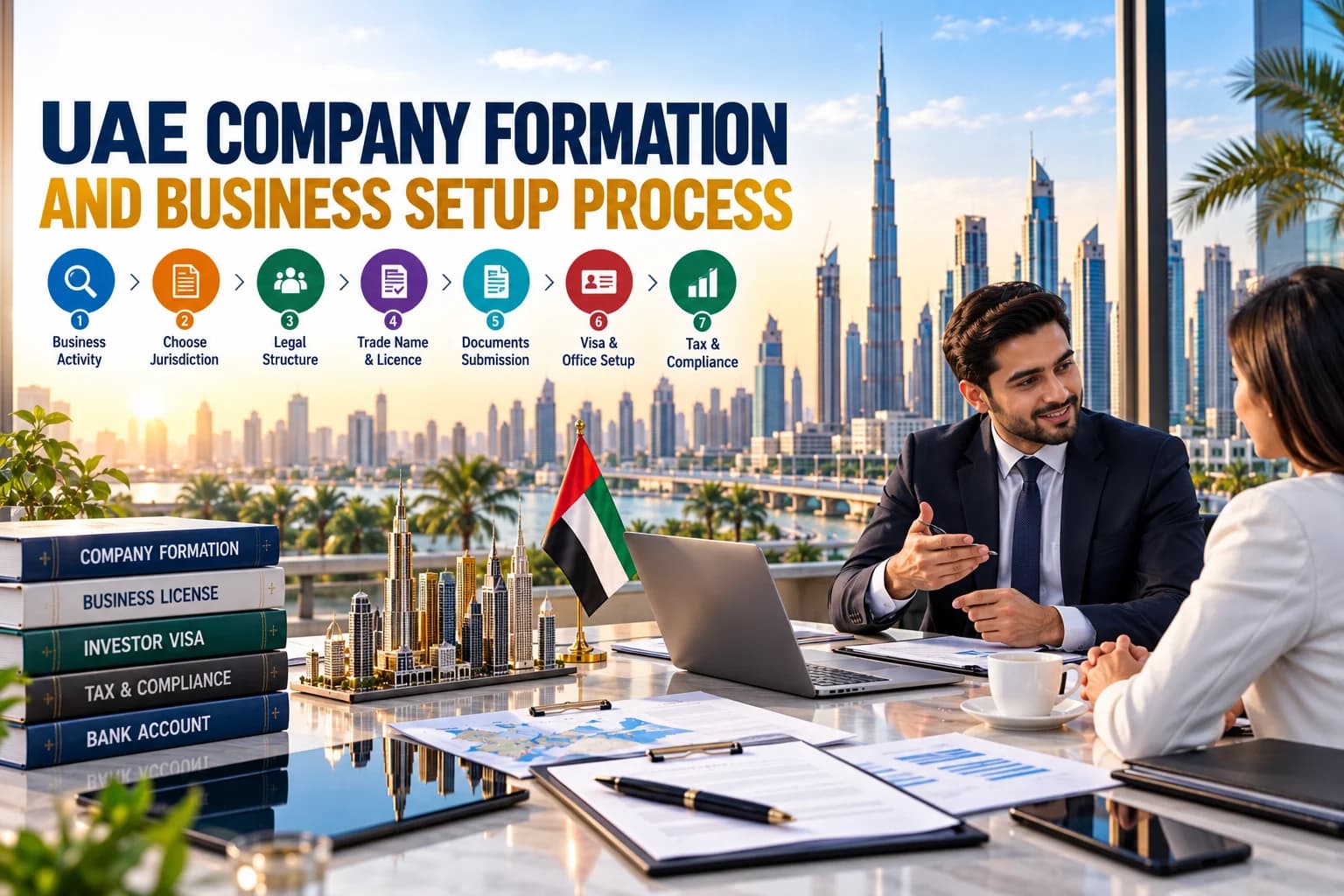
UAE Company Formation and Business Setup Process: 7 Steps
1. Select the Business Activity
The first practical step is to identify the activity the company will conduct.
Business activities can include consultancy, professional services, information technology, marketing, e-commerce, trading, manufacturing, logistics, education, healthcare-related services, and many other categories.
The selected activity should accurately reflect the company's planned operations. If an entrepreneur chooses an activity that does not adequately cover the intended business, changes or additional approvals may become necessary later.
Some activities may also be regulated or require approval from specialized authorities. Therefore, entrepreneurs should check the applicable requirements before submitting their incorporation application.
2. Choose the Jurisdiction
Once the activity is identified, the entrepreneur can evaluate mainland and free zone options.
This decision should consider the target customers, operating location, business activity, physical premises, staffing requirements, ownership structure, and future expansion plans.
For example, a company primarily providing professional services may have different requirements from a business that needs a warehouse or retail location.
The entrepreneur should also calculate recurring costs rather than focusing only on the initial setup fee. Licence renewals, office space, visas, accounting, tax compliance, banking, and other operational expenses can influence the total cost of running the company.
3. Select the Legal Form and Trade Name
The legal form determines important aspects of the company structure, including ownership and management arrangements.
The available legal forms depend on the chosen jurisdiction and business activity. Entrepreneurs should understand the responsibilities associated with the selected structure before registration.
The trade name is another important part of company formation. The proposed name needs to comply with the relevant authority's requirements and be available for registration.
Entrepreneurs should also think about branding before finalizing the name. A suitable trade name can support long-term marketing and business development.
4. Apply for the Appropriate Licence
Obtaining the correct business licence is a central part of the UAE company formation and business setup process.
The licence should correspond to the approved business activity and the selected jurisdiction. Depending on the nature of the company, the licensing route and requirements can differ.
Entrepreneurs should confirm the licence category, permitted activities, validity period, renewal requirements, premises conditions, and any additional approvals.
It is also important to distinguish between the company licence and tax registrations. Obtaining a business licence does not automatically complete every tax or compliance obligation.
5. Prepare and Submit the Required Documents
Document preparation is another important stage.
The exact documents depend on the legal structure, shareholders, business activity, jurisdiction, and licensing authority. Personal identification documents, company formation documents, business information, and other supporting records may be required.
Tax registration can involve additional documentation. For example, the Federal Tax Authority's VAT registration service identifies documents such as a valid trade licence, commercial registration documentation, incorporation or partnership documents where applicable, and identification documents for owners and authorized signatories.
Foreign entrepreneurs should also check whether documents issued outside the UAE require authentication, attestation, or other formalities.
A customized document checklist can make the process more efficient and reduce the risk of submitting incomplete information.
6. Arrange Premises and Visa Requirements
The physical presence required by a company depends on its activity and jurisdiction.
Some businesses may have flexible workspace options, while others may require a dedicated office, shop, warehouse, industrial facility, or another approved location.
Entrepreneurs should determine the premises requirement before selecting a licence because the facility can affect both setup costs and visa eligibility.
Visa arrangements should also be planned if the owner or employees intend to reside and work in the UAE. The available visa options can depend on the company structure, licence, premises, and applicable immigration requirements.
Instead of assuming that every business package includes the same visa allocation, entrepreneurs should confirm the actual terms with the relevant authority or service provider.
7. Complete Banking, Tax, and Compliance Planning
Company registration is not the end of the UAE company formation and business setup process.
Once the company is established, entrepreneurs should organize business banking, accounting, invoicing, tax registrations where applicable, financial records, licence renewals, and other ongoing requirements.
Corporate tax registration is an important consideration. The Federal Tax Authority states that taxable persons are required to register for UAE Corporate Tax and obtain a Corporate Tax Registration Number in accordance with the applicable legislation and implementing decisions.
VAT is separate from Corporate Tax. For UAE-resident businesses making taxable supplies, mandatory VAT registration generally applies when taxable supplies and imports exceed AED 375,000 over the previous 12 months or are expected to exceed that threshold within the next 30 days. Voluntary registration may be available above AED 187,500, subject to the applicable rules.
Businesses should assess their individual tax position rather than assuming that every company has identical obligations.
Documents and Licensing Requirements
The documents required during company formation depend on the proposed structure and licensing authority.
Entrepreneurs should generally be prepared to provide personal identification and information about shareholders, directors, business activities, and the proposed company. Additional corporate documents may be required depending on the structure.
For VAT registration, the Federal Tax Authority may request a valid trade licence, commercial registration certificate, incorporation documents, Emirates ID and passport copies of owners and authorized signatories, and supporting commercial records depending on the application.
Additional documents can be required for specific activities. For example, a regulated business may need approvals, professional qualifications, or other supporting evidence.
Because requirements can change, entrepreneurs should confirm the current checklist with the relevant licensing authority before submitting an application.
Tax and Compliance After Company Formation
Tax planning should be considered before the company starts trading.
The UAE operates a VAT system with a standard rate of 5%. However, VAT registration does not automatically apply to every business. The Federal Tax Authority sets mandatory and voluntary registration thresholds based on taxable supplies, imports, and applicable conditions.
Corporate Tax is a separate federal tax. A business may need to register even if it is already registered for VAT. The Federal Tax Authority specifically states that VAT registration does not replace the requirement to register for Corporate Tax where applicable.
Businesses should maintain proper accounting records and monitor filing deadlines. They should also keep their licences and corporate information updated and comply with relevant requirements applicable to their activity.
This makes professional financial management an important part of running a UAE company after incorporation.
Common Business Setup Mistakes to Avoid
One common mistake is choosing a jurisdiction based only on the lowest setup price. Entrepreneurs should consider the complete cost of operating the company, including renewals, premises, visas, accounting, banking, and compliance.
Another mistake is selecting an inappropriate business activity. The licence should reflect the company's actual operations as closely as possible.
Entrepreneurs should also avoid assuming that all free zones have identical requirements. Each free zone can have its own rules, activity lists, facility options, and commercial terms.
Ignoring tax obligations can create another problem. VAT and Corporate Tax should be assessed separately according to the company's circumstances.
Finally, entrepreneurs should maintain organized records from the beginning. Licences, contracts, invoices, tax documents, shareholder records, and renewal information should be stored systematically.
Why Choose Horizon line
Horizon line helps entrepreneurs navigate the UAE company formation journey by organizing the major stages involved in establishing a business.
For entrepreneurs researching the UAE company formation and business setup process, Horizon line can help them understand considerations such as business activity, jurisdiction, legal structure, licensing, documentation, premises, visas, and ongoing compliance.
The goal should be to identify a setup that matches the company's actual business model rather than selecting a structure based solely on promotional pricing.
Horizon line can also help entrepreneurs approach the process with a clearer understanding of the information they need to provide and the decisions they need to make before company registration.
Since UAE licensing, tax, immigration, and authority procedures can change, entrepreneurs should verify the current requirements applicable to their specific company before proceeding.
Frequently Asked Questions
What is the UAE company formation and business setup process?
The UAE company formation and business setup process generally involves selecting a business activity, choosing a jurisdiction and legal structure, reserving a trade name, obtaining the appropriate business licence, preparing documents, arranging premises and visas where applicable, and completing tax and compliance requirements.
How long does the UAE company formation and business setup process take?
The timeframe varies depending on the business activity, jurisdiction, legal structure, documentation, external approvals, and whether premises or additional permissions are required. Straightforward applications can follow a simpler process, while regulated or more complex activities may require additional steps.
Can a foreign entrepreneur establish a company in the UAE?
Foreign entrepreneurs can establish companies in the UAE, subject to the applicable rules for their chosen activity, jurisdiction, legal structure, and immigration status. The specific requirements should be confirmed before incorporation.
What is the difference between mainland and free zone company formation?
A mainland company and a free zone company can have different licensing authorities, permitted activities, premises requirements, visa arrangements, and operating conditions. The appropriate option depends on the company's intended activities and commercial requirements.
What documents are required for UAE company formation?
The exact documents depend on the business and jurisdiction. Entrepreneurs may need identification documents, trade name information, incorporation documents, licence applications, and premises-related records. Additional documents may be required for regulated activities or specific ownership structures.
Is VAT registration required after company formation?
VAT registration depends on the business's taxable supplies, imports, and applicable registration rules. For UAE-resident businesses, the mandatory threshold is generally AED 375,000, while the voluntary threshold is AED 187,500, subject to the applicable conditions.
Does every UAE company need Corporate Tax registration?
Taxable persons within the scope of UAE Corporate Tax are required to register with the Federal Tax Authority under the applicable rules. Corporate Tax registration is separate from VAT registration.
Conclusion
Understanding the UAE company formation and business setup process helps entrepreneurs make informed decisions before launching their company. From selecting the correct activity and jurisdiction to choosing the legal structure, obtaining a licence, preparing documents, arranging premises, and planning tax compliance, every stage can influence how the business operates.
Mainland and free zone structures can serve different commercial needs, so entrepreneurs should evaluate the complete business model rather than focusing only on initial setup costs. They should also plan for recurring expenses, tax obligations, licence renewals, accounting, visas, and ongoing compliance.
Horizon line can help entrepreneurs understand the company formation journey and organize the key requirements involved. If you are planning a new venture and need guidance on the UAE company formation and business setup process, contact Horizon line to discuss your business activity, preferred jurisdiction, licensing requirements, documentation, and next steps.